Thursday, October 24, 2013

Crtical thinking flaws in: "The Rape Epidemic Doesn't Actually Exist"


Critical thinking flaws in:

"The Rape 'Epidemic' Doesn't Actually Exist"

(By Caroline Kitchens)

http://www.usnews.com/opinion/blogs/economic-intelligence/2013/10/24/statistics-dont-back-up-claims-about-rape-culture

The writer introduces the topic well with this reasonable description of the topic of her post:
               

 A group of 100 protesters – including many topless women – recently marched the streets of    Athens, Ohio chanting, "Blame the system, not the victim" and "Two, four, six, eight, stop the violence, stop the rape." Organized by an Ohio University student organization called "f*ckrapeculture," the protest was designed to bring attention to what the founders believe is a   toxic culture of sexism and sexual violence infecting their campus.

Kitchens claims that the recent efforts of rape awareness activists is, "...built on a foundation of dubious statistics and a distorted view of masculinity." She offers no example or proof of what that "distorted view of masculinity" is or how it is manifested. The link the writer uses to offer evidence of dubious statistics was written in 1994 and based on statistics from even earlier.  It would seem that the writer is picking and choosing what statistics are valid with little method.

Kitchens claims that these certain statistics are unreliable, "...primarily because of vague and expansive definitions of what qualifies as sexual assault." The assertion ignores the widely known fact that many sexual assaults go unreported, which would also skew the numbers. The writer dismisses  a poll from  the Department of Justice that the activists have used to support their efforts, but uses one of their (old) reports in the very next paragraph. 

At this point I am starting to wonder why Caroline Kitchens is so tough on the universities who, " have recently reviewed and revised their policies. " And claims, "It is not clear that these policies have made campuses safer places for women, but they have certainly made them treacherous places for falsely accused men." So I click on her profile and find this is the only blog post. I have no evidence, but I suspect a troll.

The writer chooses to relay the story of the young man featured in the post's only photo, but does not offer the anecdotes from the other perspective. The case Kitchens chooses to profile was also not one where the victim later recanted, which may have supported the argument more strongly. The author lacks any statistical evidence of the frequency of false accusations.

I believe the writer began the article with a point to prove, rather than a question to answer. This led to statistical cherry-picking and an oversimplification about the plight rape awareness activists are fighting. The author fails to prove the claim asserted in the title of the article.

Wednesday, October 23, 2013

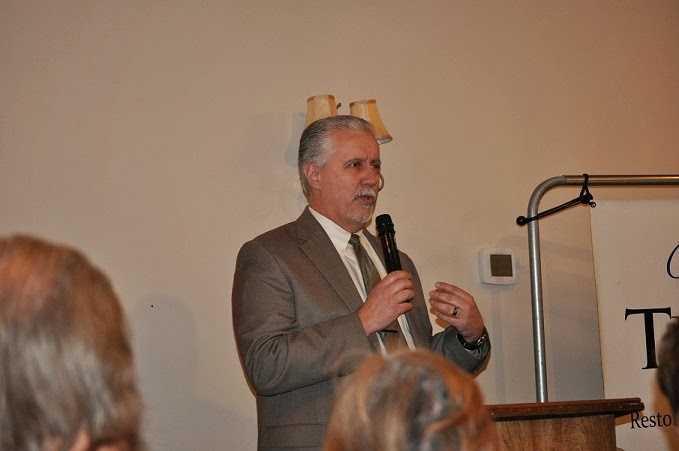
Lt. Gov. Dan Forest hosts town hall meeting in Concord, NC


In spite of the deep lateral divides in the Republican party, there are a still a few subjects capable of uniting. On Monday night Lt. Governor Dan Forest, Rep. Larry Pittman (82nd district) and Rep. Carl Ford (76th district) met with dozens of citizens at Concord's Old Creamery Event Place. The Tea Party group, We the People Inc, sponsored the gathering with catering from The Wayside Diner. The town hall meeting is one of the many Lt. Gov. Forest has headlined around the state. 

Rep. Ford began with a speech that declared the federal case against North Carolina's Voter Id law was merely a delay tactic to keep a perfectly legal law from being enacted before the 2014 election. When asked about the claim that the law will adversely minority voters he responded by stating that it could not, as obtaining an ID is fairly easy and that the state will pay to help those without one.
Rep. Ford also advises citizens to make their voices heard before the General Assembly is in session. He suggests that short, sweet, and personalized messages are much more effective in reaching legislators than mass emails.


After a prayer, Rep. Pittman declared that a recent mass email depicting President Obama as a traitor was simply not true, he hadn't done anything to betray Kenya. The crowd responded enthusiastically and Pittman went on to support the Voter ID law. He claimed that voter fraud was not only committed by minority groups, therefore the new law could not be said to single out one group over another. In response to the low incidence of voter fraud Pittman said, "We know there is voter fraud in some places so why not make sure it doesn't come here?"


Lt. Gov. Forest took the stage next and began with a speech similar to the ones he has given around the state in recent weeks; he said tax reform efforts in North Carolina have moved the state from number 44 to 17 in a list of states with favorable taxes for business. He defended the state's decision to not expand Medicaid, citing “good math.”


The separation between Tea Party candidates and establishment Republicans was highlighted when Forest declared “Dam Mitch McConnell” ought to be the new name of the Kentucky dam project that was funded in last week's bill to reopen the government. The crowd responded with hoots and laughter for support. In response to a question about how conservatives will fair in 2014 Forest said, 

"There is the Republican Party, the Tea Party, the Libertarian movement, Conservative movement; there are a lot of individual movements going out there and there is no unity out there to hold it all together. I think that is a great challenge that we face."

When the Common Core Standards were addressed the people came alive, shouting demands that the State write a check to return the $400 million federal Race to the Top grant it accepted in return for adopting the recently revealed standards. Forest responded, "There is a lot of sentiment out there for that and I believe that is the way it should happen....The legislature has every opportunity in the world to put the pause on this."  

He says North Carolina accepted the standards “sight unseen” and will have to work to implement them, even though, "I don't think standards in and of themselves are the things that are going to transform education in our country."

One member of the audience asked Forest about Senate Bill 14, the first bill Gov. McCrory signed into law, calling for diplomas to reflect a student's “career readiness” or “college readiness. The concerned man has been a teacher for 15 years and does not want to see kids labeled before they get out into the world. Forest neither defended or supported the measure, but claimed that pairing teens with vocations and apprenticeships at young age ensured better employment and might solve the problem of unemployed college graduates. 

Forest has been repeatedly reminded of his statement that N.C.'s teachers ought to be the highest paid in the nation, but has back-pedaled in his last few appearances. Comprehensive tax reform passed earlier this year and it failed to address teacher pay. Forest now says that teacher pay isn't as low as it seems as N.C. Teachers have a low cost of living, great healthcare benefits, and other perks. 

Forest said he could not comment on the State Board of Education's lawsuit against the state about funding for the More at Four program, as he is a voting member of the board

Enthusiastic questions and concerns came from an Asheville group promoting medical marijuana rights in the South East. Two women from The Buzz (NORML newsletter), a cancer survivor, and Todd Stimson wanted to know why a bill allowing cannabis for medicinal purposes was stalled before the end of the last session. Forest said it wasn't a pressing issue for lawmakers, which raised questions about lawmaker complaints that they had been “annoyed” by overwhelming support for the bill. 
 
Forest was bombarded with more questions; why should a non-violent marijuana user be labeled a felon and lose the right to a driver's license and voting? Todd Stimson suffered that fate when his business, Blue Ridge Medical Cannabis Research Corporation was raided in 2011. Stimson had been paying taxes and disclosed the nature of his research to the state. Forest agreed that the penalties were too steep and non-violent offenders, "need to be able to be assimilated back into our society again." He said he is working with his brother, the Chief Federal Probation Officer of Western N.C., the Department of Transportation, and the Department of Public Safety to resolve this issue.

When more questions related to cannabis arose he said, "This is not the cannabis town hall...this is not my issue, you can take it up with your other legislatures."

The meeting came to end after Forest answered the last question, what exactly is your job? It is to be a voting member on a number of boards, host town hall meetings, and to be voice between citizens and the state. 

Lt. Gov. Dan Forest was elected independently of Governor McCrory, his website has not been updated since he won the nomination in 2012.

Friday, October 18, 2013

Google's "Shared Endorsements" alarm privacy activists

Beginning on November 11 Google will begin using our comments and reviews to send advertisements to other users. These “Shared Endorsements” mark a new step in the efforts of social media websites to cash in on untapped advertising opportunities. These ads will be produced by searching for keywords in past and present social media activities. By using one's picture and full name, advertisers are hoping for a strong reaction to certain products from your circle of friends

Privacy activists are concerned that this type of advertising obscures the user's original intent and fails to compensate users for their endorsements. Readers may be reminded of the recent lawsuit that left Facebook owing $20 million after rolling out a similar plan. Google may have resolved the legality issue with a careful notification program and providing plenty of time to allow people to opt out of the program. To opt out of the program log into Google Plus and then select: Settings, Shared Endorsement, Edit, and un-check the permission box.

But some privacy activists suggest this isn't enough. Janet Davison of the Canadian Broadcasting Corporation quotes Sidneyeve Matrix, a media professor at Queen’s University in Kingston, Ont.,
"Google’s in the courts right now and they were arguing that people don’t have a reasonable expectation of privacy in our email. So I think that we can’t rely on the privacy settings."

We are entering a new era of advertising and Online community. The courts may have the biggest say in the structuring of America 2.0; but Google Inc (GOOG.O) did set a record on the S&P 500 today, it's stock is now worth over $1,000 a share.

Thursday, October 10, 2013

Malala Yousafzai on The Daily Show

Malala Yousafzai on The Daily Show with Jon Stewart

On  Tuesday, October 8 Malala Yousafzai sat down for a touching and empowering interview with Jon Stewart of The Daily Show. Yesterday, 9 October 2013, marked the first year of her survival after a Taliban attack. The assassination attempt came after years of outspoken criticism against the Taliban's anti-education campaign. She informs us, that since 2007, 400 schools have been bombed. "The bravest girl" finds a lot of her inspiration from her father, also an advocate for education and women's rights.

Malala still crusades for the right to education in Pakistan.She believes the Taliban denies education to girls in order to retain power and control in the region. She says, "You must fight others [the Taliban] through peace and dialogue and education." 

According to CNN, Malala has won the European Parliament's Sakharov Prize for Freedom of Thought. On Amazon's Best Sellers list I am Malala, her new book, is already at the number two position. Malala Yousafzai is an integral cog in the machine that will eventually rid the world of crimes against women.


 The Daily Show with Jon Stewart. 8 October 2013
Video retrieved from http://www.youtube.com/watch?v=f506lCk6Tos

Thursday, October 3, 2013

Federal charges against North Carolina Voter ID Law

The Attorney General, Eric Holder, has announced that the Federal government will pursue action in the courts to prevent North Caronlina from enacting new and restrictive voter ID legislation The Voter Information Verification Act was signed into law by Governor Pat McCrory in August of this year. 

The law introduces a number of changes; early voting will be shortened by a week. All voters must present photo ID, unless having a photo taken violates religious rights or a declared natural disaster has occurred. In addition, voters can no longer register on the same day, voters can be challenged at the voting booths, and it will be illegal for voting stations to stay open longer than the posted hours (even if there is still a line).
Adam Serwer, of MSNBC, wrote an article on the 1st of October about the details of the state law and the precedence the Court's decision will set. By selecting to insert the following quote from a pundit Serwer demonstrates that he understands what the audience at MSNBC wants to read.

“It’s a little hard for North Carolina to feign ignorance and pretend this was all the outcome of a neutral, rational legislative process,” says Brenda Wright, an election law expert with the liberal think tank Demos. “If you choose to carry out partisan ends by deliberately disenfranchising some voters of color, you can’t pretend that’s not discrimination.”


With all of these restrictions and because it was passed very shortly after the Supreme Court's ruling, it is no surprise that the administration decided to pursue challenges to the laws from North Carolina and Texas. In a statement Eric Holder describes the law as a burden primarily on the backs of minorities and as an effort to “contract the electorate.”

The Justice Department seeks to use Section 2 of the Voting Rights Act to block the laws from being implemented. They will also request the implementation of Section 3, requiring the state to gain federal approval before initiating any other election laws.

The lawmakers in North Carolina claim the law was written to prevent fraud and ensure the “integrity” of the election process. The statement begs the question, what integrity is there in restricting a citizen's Constitutional Right? Serwer casts doubt on that claim with this statistic, “In 2012, according to NBC affiliate WNCN, voter fraud referrals accounted for 0.00174 percent of the ballots cast, and 0.000738 percent in 2010.”

The important precedent this decision will set may change the shape of our country's electorate dramatically, for better or worse.


http://tv.msnbc.com/2013/10/01/high-stakes-in-battle-over-north-carolinas-voter-id-law/

Thursday, September 26, 2013

New Intelligence Oversight and Surveillance Reform Act

Today, September 26,th,The Guardian's Paul Lewis reports on a new piece of legislation introduced in the Senate, a bi-partisan effort named The Intelligence Oversight and Surveillance Reform Act. It “is the most comprehensive package of surveillance reforms presented to the Senate so far. It merges competing legislative proposals announced by various senators before the summer recess, and cherry-picks from ideas contained in a dozen other draft bills that surfaced in both the Senate and House of Representatives, following disclosures by whistleblower Edward Snowden.”
This bill may see success because of the issue's unique ability to unite democrats and republicans; Senators Wyden, Udall, Blumenthal, and Rand presented the bill which strives to:
Ban the mass collection of phone-record data: The bill would only allow mass collection of data in case of a massive emergency and only from a specific person if he or she is suspected of terrorism or espionage. This ban would not apply to non-citizens.

Ban the collection of internet communication data: Apparently the NSA has already begun to limit this type of mass collection, but the bill would dismantle the “legal framework” that allows it (leaving a loophole for emergencies).

Close search loopholes: “...the bill closes the loopholes that would potentially permit intelligence officials to search wholly domestic American communications that have been swept up in the dragnet, authorised under section 702 of the Fisa Amendment Act, which is intended for targeting foreigners. This section of the bill essentially cleans up this area of law, ensuring that the NSA and partner bodies would need to obtain warrants and prove terrorist connections before searching for communications of US citizens or people residing in the US.”

Reform the surveillance court: “One frequent complaint regarding the Foreign Intelligence Surveillance Court (known as the Fisa court) is that the bias is built into the system, with judges, whose rulings are not released, only ever hearing the government's case for warrant applications.

The bill seeks to redress that imbalance, inserting some degree of adversarial process into the Fisa court's proceedings, but only in significant or precedent-setting cases. To do so, it would appoint a "constitutional advocate", independent from the executive branch, to serve as a watchdog in important cases – although legal arguments would still be classified, taking place behind closed doors. The advocate would be appointed by the chief justice, choosing from a shortlist created by the Privacy and Civil Liberties Oversight Board, a body that will be mandated by statute to nominate attorneys who would be "zealous and effective advocates in defense of civil liberties".
This article is important and relevant to us all, not just as journalists, but as citizens. I don't want to hold my breath, but this type of bi-partisan legislation is what we need as the world continues to change in the information age. I hope this bill doesn't get pushed aside as the budget debates loom over us.


http://www.theguardian.com/science/2013/sep/26/nasa-curiosity-rover-mars-soil-water

Monday, September 23, 2013

Why Snowden was right

When the Edward Snowden story first broke I was of the opinion that many were. None of his leaks seemed to reveal anything that we hadn't learned from other leakers in the last few years. It seemed like Snowden was seeking international fame at the expense of discrediting the U.S. Government. To be fair, a lot of the information that was first leaked was information revealed in the past, perhaps Snowden felt that the public needed to be reminded of the failure of those leaks to affect change. Nonetheless, the leaks increasingly revealed more and more about domestic and overseas spying programs. After I heard Snowden's interview with Laura Poitras and Glenn Greenwald (Guardian, U.S.) in Hong Kong on June 6, 2013 I started to change my mind. I have worked in the intelligence community and I understand that, upon realizing the scope of American misinformation, Snowden felt he had a duty to reveal. It seems many agree that journalists and leakers deserve protection, as The Free Flow of Information Act of 2013 is currently being reviewed in Congress and grants better protections for those with delicate information to publish (and leaves the definition of journalist open for interpretation). While it seems cowardly to run, how else could Snowden continue this work and avoid the black hole of a treason trial? Snowden even took care to avoid leaking certain sensitive information and has not acted like someone trying to bring harm to the people.

Today many see Snowden's leak as a blow to the country's protection and security, and that seems to be the difference in the climate and time between Snowden's leak and the eventual release of the Pentagon Papers. The public's trust lies closer to the government today. We have proof that, after 9/11, there were numerous terrorist attacks prevented. The Pentagon Papers were released at a time when the people were willing to look at lies from the government as dangerous for us all. Journalists were more comfortable and supported in the endeavor to ensure the country was “in the light” and deserved to choose their leaders with this knowledge in hand. Today, many citizens don't understand how a meta-data surveillance program affects them, after all they are not committing any crimes. Many people feel that they are not losing much privacy under some of these surveillance programs; but didn't they deserve to debate that before the programs began?

Some support Snowden because they feel a wrong is being committed by our government; others because they feel a wrong is being committed by our telecommunications companies. Glenn Greenwald, of The Guardian, reported on June 5, “The National Security Agency is currently collecting the telephone records of millions of US customers of Verizon, one of America's largest telecoms providers, under a top secret court order issued in April.” Should Verizon have filed some sort of lawsuit or even exposed the request to the media? The FISA court threatens the ability of companies to act in the best interest of their customers and dangles the unimaginably serious threat of treason as a punishment. This threat limits the scope of the debate on security and privacy, limiting our free speech.

But it seems there are even more unintended consequences when starting secret spying programs, according to the Guardian on 20 September,

“Many cryptographic systems in use on the internet, it seems, are not "properly implemented", but have been weakened by flaws deliberately introduced by the NSA as part of a decade-long programme to ensure it can read encrypted traffic.”

and

“...it appears to involve getting software companies and internet service providers to insert secret vulnerabilities, or backdoors, into apparently secure systems. This can be done by introducing deliberate errors into software or hardware designs, many of which are developed in collaboration with the NSA; or by recommending the use of security protocols that the NSA knows to be insecure, in its dual role as cryptographic standards-setter and codebreaker.”

This means all of our secure and encrypted Online exchanges are no longer secure. The NSA's secret search for security has resulted not only in a loss of privacy, but also security.

For those interested in the repercussions of losing privacy Online, check out the United Nation's report here.